
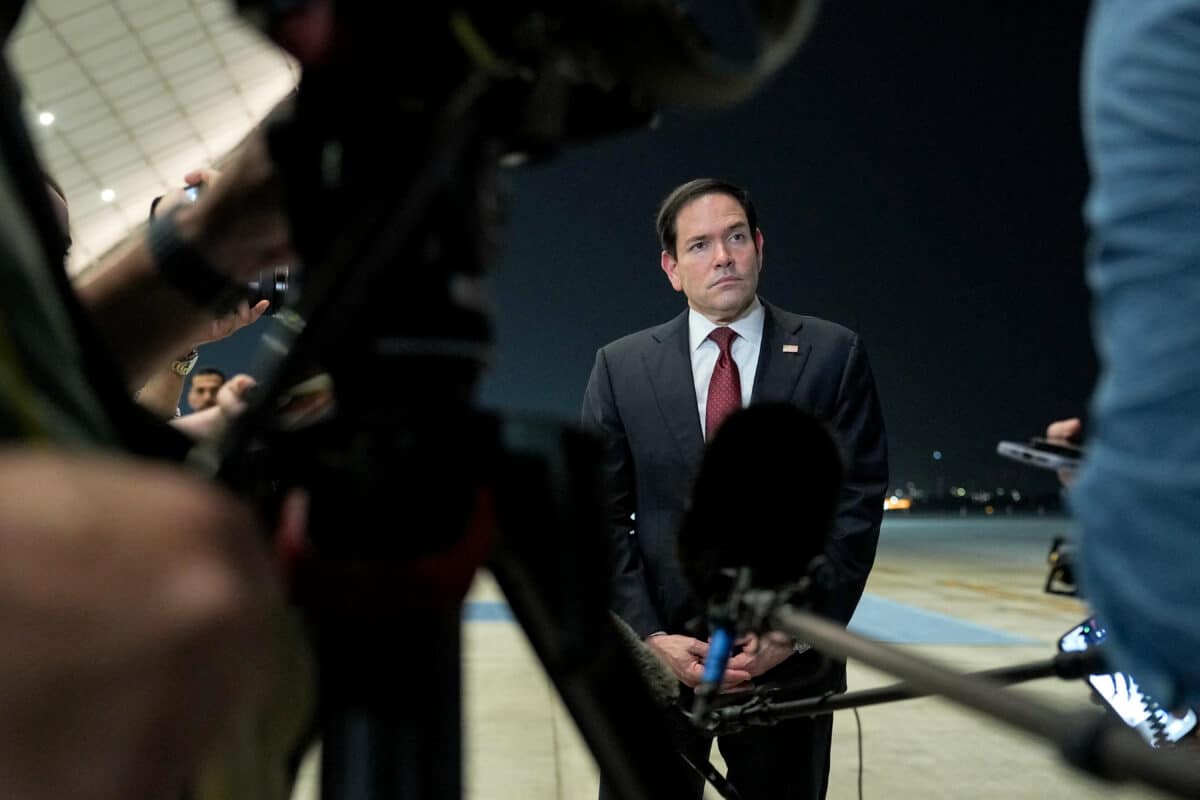
TEHRAN — U.S. Secretary of State Marco Rubio said Tuesday that the United States would oppose any Iranian effort to impose tolls or fees on vessels using the Strait of Hormuz, as Washington and Tehran continued negotiations aimed at ending the Middle East conflict and resolving disputes over sanctions, nuclear inspections and regional security.
Rubio made the remarks during a visit to the United Arab Emirates after Iran and the United States signed a preliminary agreement to halt hostilities and completed an initial round of talks in Switzerland. The agreement established a 60-day negotiation period focused on sanctions relief, Iran’s nuclear program and the future of the Strait of Hormuz.
The strategic waterway experienced significant disruptions earlier in the conflict after an Iranian blockade reduced maritime traffic and contributed to higher global oil prices. Shipping activity has increased since the agreement was signed.
On Tuesday, Iran and Oman said in a joint statement that they would study the administration of the strait and possible service charges while maintaining their sovereignty claims over the waterway.
Rubio rejected the possibility of tolls on vessels using the route.
“It’s an international waterway. No country is allowed to charge tolls or fees on an international waterway,” Rubio said.
Iranian negotiator Mohammad Bagher Ghalibaf earlier said the Strait of Hormuz would not return to its prewar status, although both sides agreed to establish communication channels to keep the waterway open.
The International Maritime Organization said it would begin evacuating more than 11,000 sailors stranded by the blockade after securing safety guarantees from Iran, Oman and the United States.
According to maritime tracking platforms, vessel traffic through the strait reached its highest level Monday since the conflict began, although it remained at just over 40 percent of the normal peacetime average of about 120 vessels per day.
Diplomatic efforts continued Tuesday as Iranian President Masoud Pezeshkian visited Pakistan, a mediator in the negotiations, while Rubio began a tour of Gulf allies. Lebanese and Israeli officials also opened a new round of talks in Washington.
Iran signaled that its ballistic missile program remains outside the scope of any final agreement.
Pezeshkian said Iran would not negotiate over its defensive capabilities, arguing that the country’s missile program serves as a deterrent against military threats.
Pakistani Prime Minister Shehbaz Sharif said the preliminary U.S.-Iran agreement does not address ballistic missiles.
The missile issue remains a major concern for Israel, which has long viewed Iran’s missile program as a security threat. During the conflict, Iran launched hundreds of missiles and thousands of drones at Israel and neighboring countries.
Questions also emerged over future international inspections of Iran’s nuclear facilities.
Iran denied a claim by U.S. Vice President JD Vance that Tehran had agreed to allow inspectors from the International Atomic Energy Agency (IAEA) to return to nuclear sites damaged during U.S. and Israeli strikes in 2025.
President Donald Trump said Iran had agreed to extensive nuclear inspections, but Iran’s ambassador to the United Nations, Ali Bahreini, said no such decision had been made.
The United States and Israel struck nuclear facilities at Fordow, Natanz and Isfahan during the 2025 conflict. Officials have not released a definitive assessment of the damage.
Mediators from Pakistan and Qatar said the United States and Iran agreed on a roadmap to pursue a final agreement within the 60-day negotiating period.
The U.S. Treasury Department has temporarily eased sanctions to allow Iran to continue producing and exporting crude oil and related products through mid-August.
Iranian state media reported that Washington also agreed to release $12 billion in previously frozen Iranian funds as part of the preliminary agreement.
Meanwhile, the U.S. Senate approved a House-passed resolution calling for an end to the conflict with Iran. Although the measure carries disputed legal authority, the vote placed both chambers of Congress on record in support of ending the war as negotiations continue.
In Washington, Lebanese and Israeli officials opened a fifth round of talks Tuesday aimed at ending the conflict between Israel and Hezbollah, which has repeatedly threatened broader regional peace efforts.