
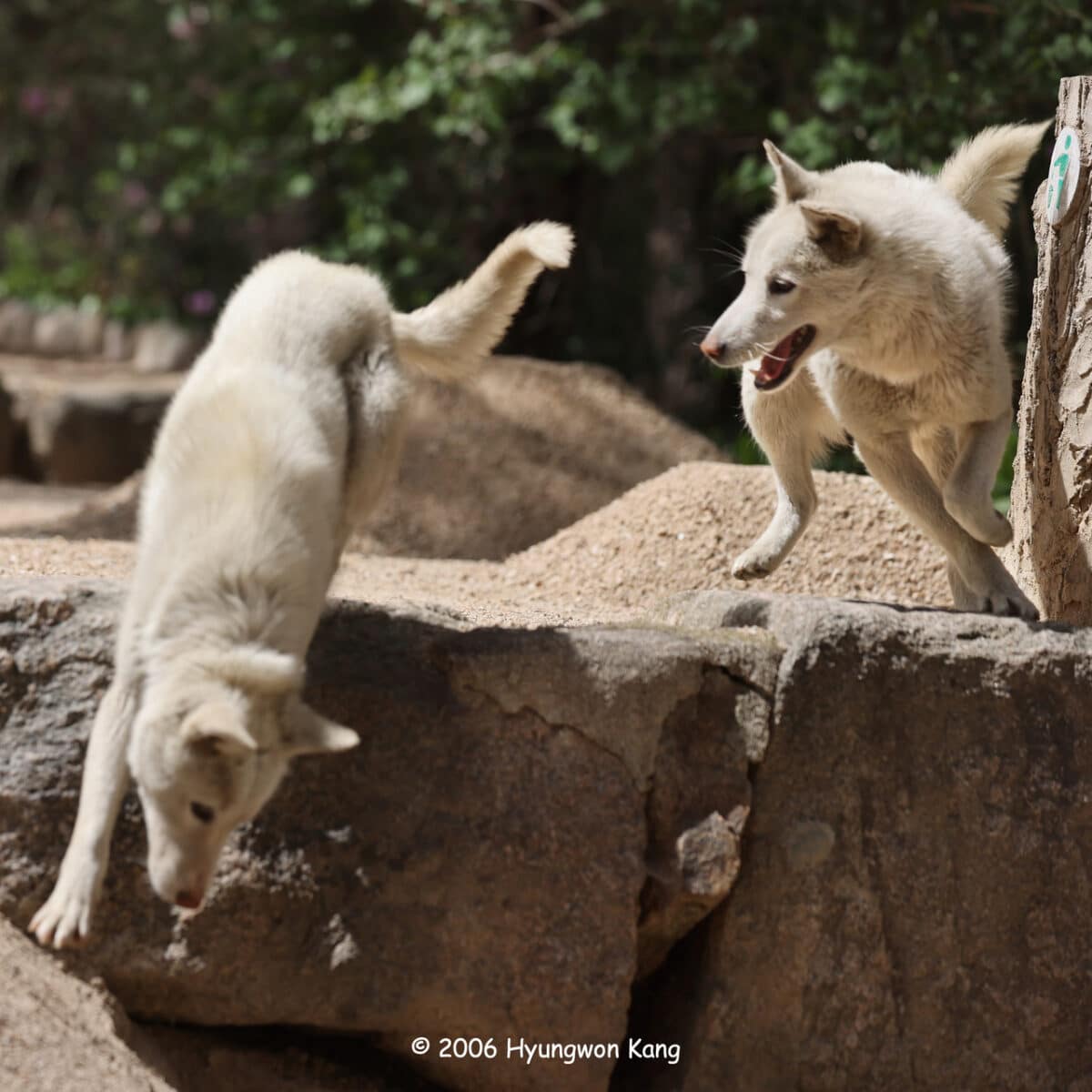
KAESONG, North Korea — Recent genomic studies have traced the origins of Korea’s indigenous dog breeds, including North Korea’s national dog, the Pungsan-gae, to multiple ancient East Asian lineages, offering new insights into the peninsula’s canine history.
The findings build on earlier documentation of the Pungsan-gae, a hunting breed native to the mountainous region of what was formerly Pungsan County in present-day Ryanggang Province.
The breed gained wider recognition in South Korea after North Korea presented a pair of Pungsan dogs to former President Kim Dae-jung following the 2000 inter-Korean summit. The dogs became symbols of reconciliation between the two Koreas.
North Korea designates the Pungsan-gae as one of its natural monuments and recognizes it as the country’s national dog.
Researchers at Konkuk University analyzed the whole-genome sequences of 211 canids in a 2023 study to reconstruct the evolutionary history of Korea’s native dogs.
The study found that Korea’s indigenous breeds developed through the convergence of two ancient genetic lineages.
One lineage is closely related to indigenous dogs from Southeast Asia, including the New Guinea singing dog, the Australian dingo and native Vietnamese dogs. The Jindo and Donggyeongi breeds primarily belong to this group.
The second lineage is associated with northern Eurasia and includes the Sapsal, whose closest relatives include the Tibetan mastiff, Siberian husky and native dogs of Central Asia.
In 2026, Korean researchers reported the first complete genome sequences from dogs that lived on the Korean Peninsula about 2,000 years ago.
The combined findings indicate that Korea’s native dogs did not descend from a single ancestral population but instead emerged through the interaction of multiple East Asian lineages over thousands of years.
According to canine researcher Ha Jihong, genomic analyses place Korea’s indigenous breeds within a distinct East Asian lineage that differs from the three major Western dog groups.
Ha said the Pungsan, Jindo, Sapsal, Donggyeongi and Jeju dog developed as natural landraces through long-term environmental adaptation and practical selection by hunters and farmers rather than through the intensive selective breeding that produced most modern pedigree dogs in Europe.
The research also provides additional context for photographs taken in 1995 that documented Pungsan dogs at the Pyongyang Central Zoo, offering an early visual record of the breed before it became widely known outside North Korea.