
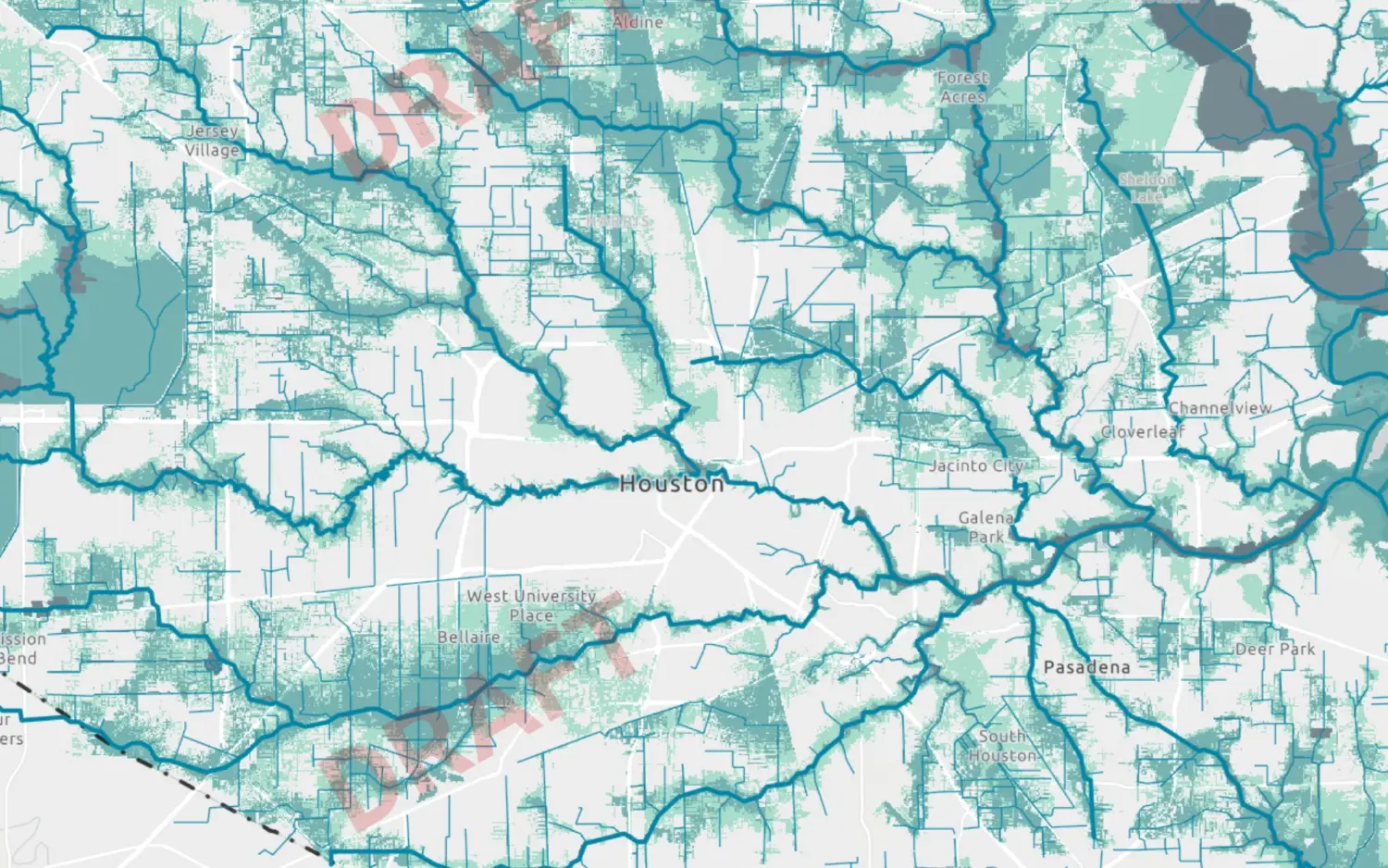
HOUSTON — A newly proposed flood risk map from the Federal Emergency Management Agency adds heightened flood risks for households across the Houston area, officials said, as the draft undergoes technical review before final approval.
The map, released on the agency’s website two weeks ago for floodplain administrators, represents a major revision of Harris County flood zones that have not received a comprehensive update in nearly 20 years. The proposal is expected to influence insurance coverage requirements and local development rules.
Under the draft, the 100-year and 500-year floodplains expanded widely in south Houston, while some areas in southwest Houston showed reduced flood risk. Both floodplains also appeared to expand in northeast Harris County near Lake Houston.
Jim Blackburn, an environmental law professor at Rice University, said a reevaluation of rainfall rates is one of the most significant developments since the county’s previous flood maps were issued in 2007. The proposed map reflects an approximately 30% increase in rainfall rates.
The 2007 maps, which remain in use until officials evaluate the proposal, estimated that properties in 100-year floodplains could flood with 13 inches of rain within 24 hours. The new maps assume about 17 inches of rain over the same period.
“That increase, we saw it with Allison, we saw it with Harvey, we saw it with Imelda … flooding that we had all in the last 20 years,” Blackburn said. “So the numbers are going up. With bigger rains, you’re going to have bigger floodplains.”
The Harris County Flood Control District, which works with FEMA to provide technical data for updated maps, published a user-friendly version of the proposal Monday that allows residents to compare potential household risks. Before the draft was released, the district updated county topography and mapped an additional 400 miles of channels.
Emily Woodell, a district spokesperson, said some changes reflect progress from flood mitigation projects funded through the county’s 2018 flood bond program.
“That means in some neighborhoods, families who once faced repeated flooding are now seeing measurable reductions in risk,” Woodell said. “There is more work to do, but we know these projects are making a difference, and hundreds of millions of dollars in additional construction is set to begin this year.”
The county’s 34 floodplain administrators will coordinate with FEMA on revisions to the draft. Officials will also open a formal appeal process and public comment period before setting a deadline to adopt the new maps.
Tina Petersen, executive director of the flood control district, said the adoption deadline will likely be years away. After officials determined that 68% of structures that flooded during Hurricane Harvey were outside the 100-year floodplain, multiple jurisdictions pushed for updated maps, she said.
“We know that when we have access to better, more accurate information, we can have better decision making on behalf of our community, on behalf of our local governments, and for emergency preparedness,” Petersen said.
The flood control district plans to host informational webinars on the proposed changes and encourages residents to review their addresses using the district’s interactive map.