
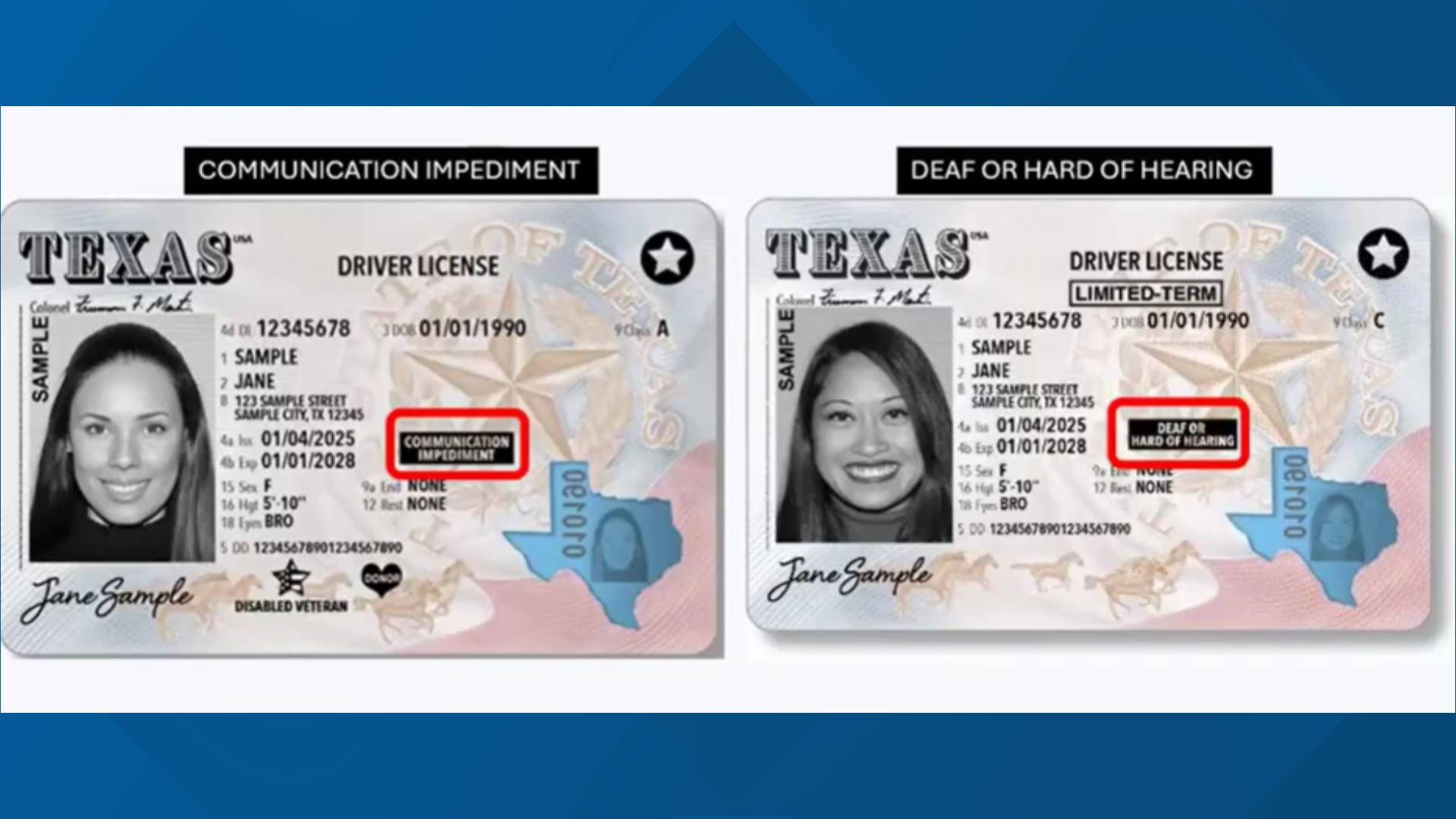
AUSTIN, Texas — Texans with hearing impairments or communication-related disabilities can now choose to have those conditions identified on their state-issued driver’s licenses or identification cards through the Texas Driving with Disability Program.
The Texas Department of Public Safety announced the update in partnership with the Governor’s Committee on People with Disabilities, saying the changes are intended to help improve communication between law enforcement officers and individuals with certain disabilities or health conditions.
Participants in the program may now voluntarily add either a “Communication Impediment” or “Deaf/Hard of Hearing” designation to the front of their license or ID card. Previously, only the communication impediment indicator was available.
To enroll, applicants must visit a DPS office in person and provide a completed Physician/Psychiatrist’s Statement Form DL-101 signed by a healthcare provider, along with the standard identification documents required for driver’s license or ID transactions.
The program covers several qualifying conditions, including autism, brain injury, cerebral palsy, deafness, Down syndrome, hearing loss, mild intellectual disability, Parkinson’s disease, post-traumatic stress disorder, and speech or language disorders such as mutism, stuttering, aphasia, speech delay, and spasmodic dysphonia.
Officials said the program is designed to help first responders and officers better understand and accommodate communication needs during traffic stops and other interactions.