
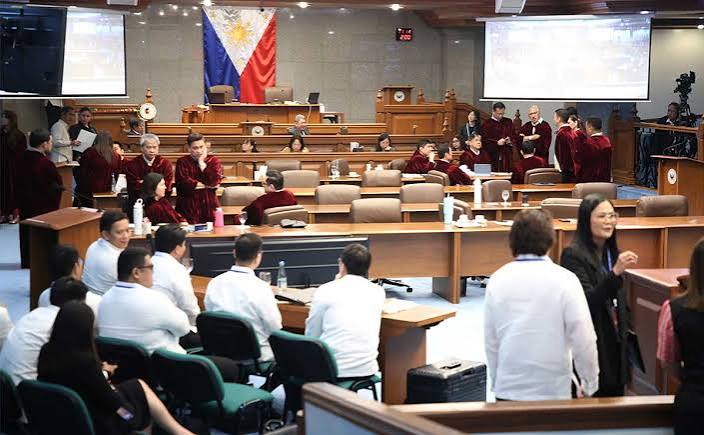
MANILA, Philippines — The Senate impeachment court will reconsider the voting threshold needed to convict Vice President Sara Duterte, with legal experts set to weigh in on Sept. 16 before the prosecution and defense present arguments on the issue Sept. 23.
Presiding officer Sen. Francis “Chiz” Escudero ordered the review after Senator-judge Erwin Tulfo formally asked the court Tuesday to reconsider Escudero’s July 6 ruling that a two-thirds vote of all 24 senators, or 16 votes, is required for conviction.
Article XI, Section 3(6) of the 1987 Constitution states that an impeached official cannot be convicted “without the concurrence of two-thirds of all the members of the Senate.”
The dispute centers on whether “all members” refers to all 24 senators regardless of whether they can participate, or only senators legally able to take part in the proceedings and final vote.
Four senators currently cannot attend the trial: Ronald “Bato” dela Rosa, who remains in hiding amid an arrest warrant from the International Criminal Court; Jinggoy Estrada and Rodante Marcoleta, who face nonbailable plunder charges before the Sandiganbayan and remain detained; and Loren Legarda, who remains abroad on extended medical leave.
Court to hear legal experts
Escudero said the court would not immediately settle Tulfo’s appeal through a simple vote because of the “sensitive and serious nature” of the constitutional question.
Instead, the court will hear from amici curiae, or “friends of the court,” on Sept. 16. The prosecution and Duterte’s defense will each receive 15 minutes to argue their positions during oral arguments Sept. 23.
The Senate will then vote on the threshold question.
Escudero said the legal experts could provide independent perspectives on the constitutional issue. The court has yet to announce their names as officials continue to confirm their availability.
Senator-judge Francis “Kiko” Pangilinan said the amici could include legal experts, retired chief justices or Supreme Court justices, and constitutional law specialists.
Legal experts divided
Retired Supreme Court Associate Justice Adolfo Azcuna said the 16-vote threshold should remain because the Constitution refers to Senate membership rather than senators who can physically participate.
“My view is that the voting threshold is based on the number of members of the Senate whether or not those members are present or able to actively participate,” Azcuna said.
Retired Supreme Court Senior Associate Justice Antonio Carpio took the opposite position, arguing that the calculation should cover only senators legally qualified to participate.
“If you cannot hold office, you cannot vote,” Carpio said.
Carpio nevertheless said Dela Rosa remained a qualified senator because the Senate had neither suspended nor removed him from office.
Former Integrated Bar of the Philippines president Domingo Cayosa said the court could lower the threshold to account for senators who can actually participate in the trial.
Cayosa described that interpretation as a “fair and practical” reading of the Constitution but acknowledged that a strict reading of the provision could support retaining the 16-vote requirement.
Tulfo raises concern over default acquittal
Tulfo questioned whether senators who cannot attend the trial should still count toward the voting requirement.
“When we refer to all members, who exactly are we counting?” Tulfo asked.
He also questioned whether absent senators could cast votes despite not participating in the proceedings or whether their absence would effectively work against conviction.
Tulfo warned that maintaining a 24-member voting base could result in an “acquittal by default” if enough senators cannot vote.
He cited Avelino v. Cuenco, which he said addresses the Senate’s coercive jurisdiction in determining its voting base and quorum.
Senator-judge Pia Cayetano challenged that argument, saying the Senate had not adopted the Supreme Court ruling as its governing rule.
Escudero said Tulfo’s appeal seeks to clarify the constitutional meaning of “all members.” He added that changing the voting base would also affect the one-third threshold for acquittal.
Tulfo urged the court to resolve the issue quickly as the impeachment trial moves ahead. The prosecution has dropped several witnesses, while Duterte’s defense has indicated that it may not present its own case.
“These developments … could bring the court to the final question sooner than expected,” Tulfo said.
He said his appeal does not seek to make conviction easier but aims to clarify how the constitutional requirement should apply under the Senate’s current circumstances.
The court will take the issue under advisement after hearing the legal experts and arguments from both sides before deciding the required voting threshold.