
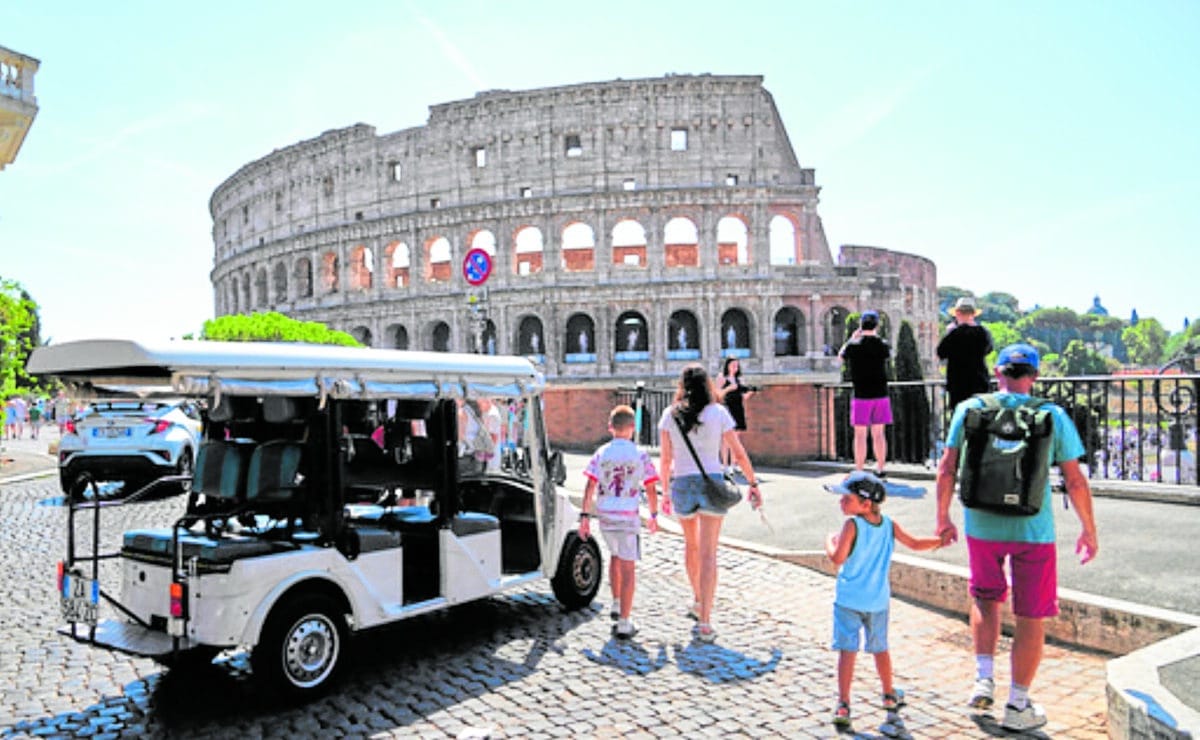
ROME, Italy — Rome plans to tighten regulations on golf carts carrying tourists through the city’s historic center as residents raise concerns about illegal parking, traffic and overtourism.
Hundreds of golf carts now operate across Rome, with bookings increasing 147% this summer compared with 2024, according to TripAdvisor. The city has as many as 500 carts, and about one-fifth belong to the Metur association of tour operators.
Critics say the carts add to congestion and worsen parking problems in an area that already sees about 50,000 vehicles enter each day.
Luigi la Licata, head of the Monti neighborhood association, said residents have dealt with traffic problems long before golf carts became common.
“This was the last straw because, unfortunately, there has already been traffic here for a long time, since there are too many categories of vehicles authorized,” la Licata said. “The golf cart is the most obvious one—and the latest—but there are many others.”
Golf cart operators argue that the vehicles offer an alternative to larger tourist buses and vans. They also point to their electric operation, which produces no tailpipe emissions and takes up less road space.
“We don’t have a proper stop for golf carts, so we park where we can—as legal as possible,” driver Martin Halili said.
The growing number of carts has also led to disputes with other motorists. During a recent ride, an eight-seat van driver confronted a golf cart driver over road space, with both drivers exchanging angry remarks.
Rome Deputy Mayor for Sustainable Mobility and Transport Eugenio Patanè said the city needs to address traffic across the historic center, not just the golf cart issue.
In July, Rome began charging electric vehicles to enter the historic center as part of an effort to reduce congestion. The city has reduced the number of authorized vehicles by about 25% to 350,000, while Patanè wants to cut the number of daily entrants by half.
Patanè said technical differences among golf carts have complicated efforts to regulate them because some vehicles fall under existing rules while others do not.
He plans to propose regulations that would establish fixed tour routes, limit the number of golf carts and other similar vehicles, and create a system for selecting authorized operators.
“Cities where this golf cart phenomenon is expanding truly have very few weapons,” Patanè said, describing the growth of the industry as a phenomenon that has become “rampant” and, in some cases, concerning.
The Metur association, established in December, says it wants to work with residents and city officials to address concerns while preserving golf carts as a transportation option for tourists.
“Overtourism is a real problem, and we’re not denying it. And maybe we’re also part of it in a way,” Metur President Pascal van Duijnhoven said. “But if we’re part of it, then at least be part of it in a smart way.”