
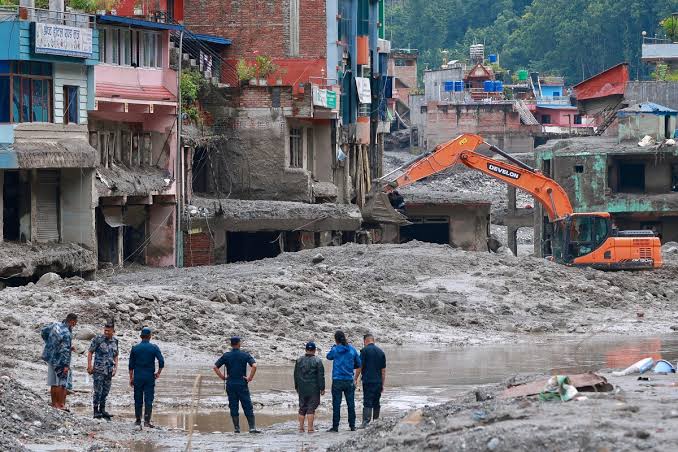
NUWAKOT, Nepal — Rescue teams in Nepal and China continued searching Saturday for nearly 3,000 people missing after a massive surge of water, mud and debris swept through Himalayan communities, killing at least 633 people across the region.
Nepal’s disaster authority reported 626 deaths and 2,426 people unaccounted for in the country. In Tibet, Chinese state media reported seven deaths and 554 missing people. Indian authorities also recovered seven bodies from rivers flowing from Nepal, which they believed could belong to flood victims.
Nepal added 933 hydropower workers to its missing persons list as rescue teams searched areas around major energy projects. The list also includes trekkers, tourists and pilgrims traveling toward Mount Kailash in Tibet.
The disaster struck Wednesday after the collapse of a glacier and surrounding rock sent a torrent of water and debris through valleys along the Nepal-China border.
Rescue efforts faced the continuing threat of additional flooding. Nepali police warned emergency workers to move to safer areas after receiving reports that another water barrier had burst on the Tibetan side.
Chinese authorities temporarily suspended rescue operations in the hardest-hit area of Gyirong because of the flooding threat before officials said conditions had improved. Xinhua reported that rescuers later saved two villagers.
The International Federation of Red Cross and Red Crescent Societies said as many as 93,000 people could have been affected by the disaster and warned that the humanitarian impact could grow as supplies of food and water decline.
In Nepal’s Trishuli valley, military rescuers continued efforts to reach more than 100 people trapped inside a tunnel at the Trishuli 3A hydropower project. Army spokesman Raja Ram Basnet said rescuers were struggling to locate the tunnel entrances because mud had covered the area.
Authorities have evacuated hundreds of people from the affected area. Nepal also reported that 555 stranded tourists and 499 Chinese residents had been evacuated from Tibet.
Survivors described communities disappearing within minutes as floodwaters tore through settlements along the river.
“All the settlements near the river were swept away. There is nothing left,” survivor Buddhi Ram Dangol told AFP.
Buddha Tamang, a worker at a hydropower project, said he survived because he was inside a tunnel when the flood hit.
“The senior officers working on the other side, they were all swept away,” Tamang told AFP.
The disaster has also left families searching for relatives who remain unaccounted for.
Samjhana Thing said she had spent three days waiting for information about her missing brother.
“We don’t know anything. Hopefully he is in a safe place,” she said.
Hundreds of people traveling toward Mount Kailash, a sacred site for Hindus, Buddhists and others, are also among the missing.
Sivaranjani Muthunathan, who was traveling with 56 others toward the Chinese border, said the group initially believed they had encountered a traffic jam before floodwaters suddenly swept through the area.
Vehicles around them were carried away or buried in mud as the group escaped through the driver’s side of their bus and climbed to higher ground.
Search and rescue operations continued Saturday as authorities assessed the full extent of the destruction across Nepal, Tibet and areas downstream in India.