
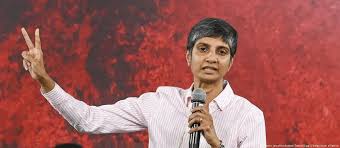
NEW DELHI — The election of constitutional lawyer Menaka Guruswamy to India’s upper house of parliament marks a milestone for LGBTQ+ representation in the country’s national politics.
Guruswamy, an openly queer lawyer and prominent advocate for civil liberties, was elected last week to the Rajya Sabha, the upper chamber of the Parliament of India. She was nominated by the All India Trinamool Congress (TMC), which has highlighted women’s representation as part of its political platform.
A graduate of the University of Oxford, Harvard Law School and the National Law School of India University, Guruswamy has built a career as a constitutional lawyer and public commentator on democracy and civil rights.
Her election also strengthens the presence of women in the TMC’s delegation in the upper chamber, with five of the party’s 13 members in the Rajya Sabha now female. Party officials said the move reflects a strategy of sending prominent public intellectuals to parliament to bolster opposition debate at the national level.
Symbolic step for LGBTQ+ visibility
Legal expert Malavika Rajkotia said Guruswamy’s election signals both LGBTQ+ visibility and a broader message about women’s leadership in politics.
“The LGBTQ angle is one, but the other is bigger,” Rajkotia said, describing the TMC’s emphasis on strong female representation.
Activists say Guruswamy’s entry into parliament could help normalize discussions around LGBTQ+ rights and broaden representation in political decision-making.
“For decades, LGBTQ people in India have often been spoken about in debates on rights and dignity, but rarely represented in the spaces where those decisions are made,” said activist Vishwa Schoolwallah.
A history of legal advocacy
Guruswamy is widely known for her role in a landmark case before the Supreme Court of India that resulted in the 2018 ruling striking down a colonial-era law criminalizing consensual same-sex relations. She argued the case alongside her partner, lawyer Arundhati Katju.
The decision was considered a major breakthrough for LGBTQ+ rights in the country.
Representation and expectations
While welcoming Guruswamy’s election, activist Sharif Rangnekar cautioned against assuming any single politician can represent the diverse LGBTQ+ community across India.
“She was ultimately chosen by the TMC to represent the party’s political interests,” he said, noting that activists will watch closely to see how her role evolves.
Unresolved legal issues
Despite growing visibility, several LGBTQ+ rights issues remain unsettled in India. In 2023, the Supreme Court of India declined to legalize same-sex marriage, leaving the issue to lawmakers in parliament.
The ruling highlighted the gap between increasing public recognition of LGBTQ+ rights and the country’s legal framework.
Activists say Guruswamy’s election could help push discussions on equality and anti-discrimination protections forward.
“Her election offers hope that the next phase of progress may move toward legislative reform,” said LGBTQ+ advocate Keshav Suri.