
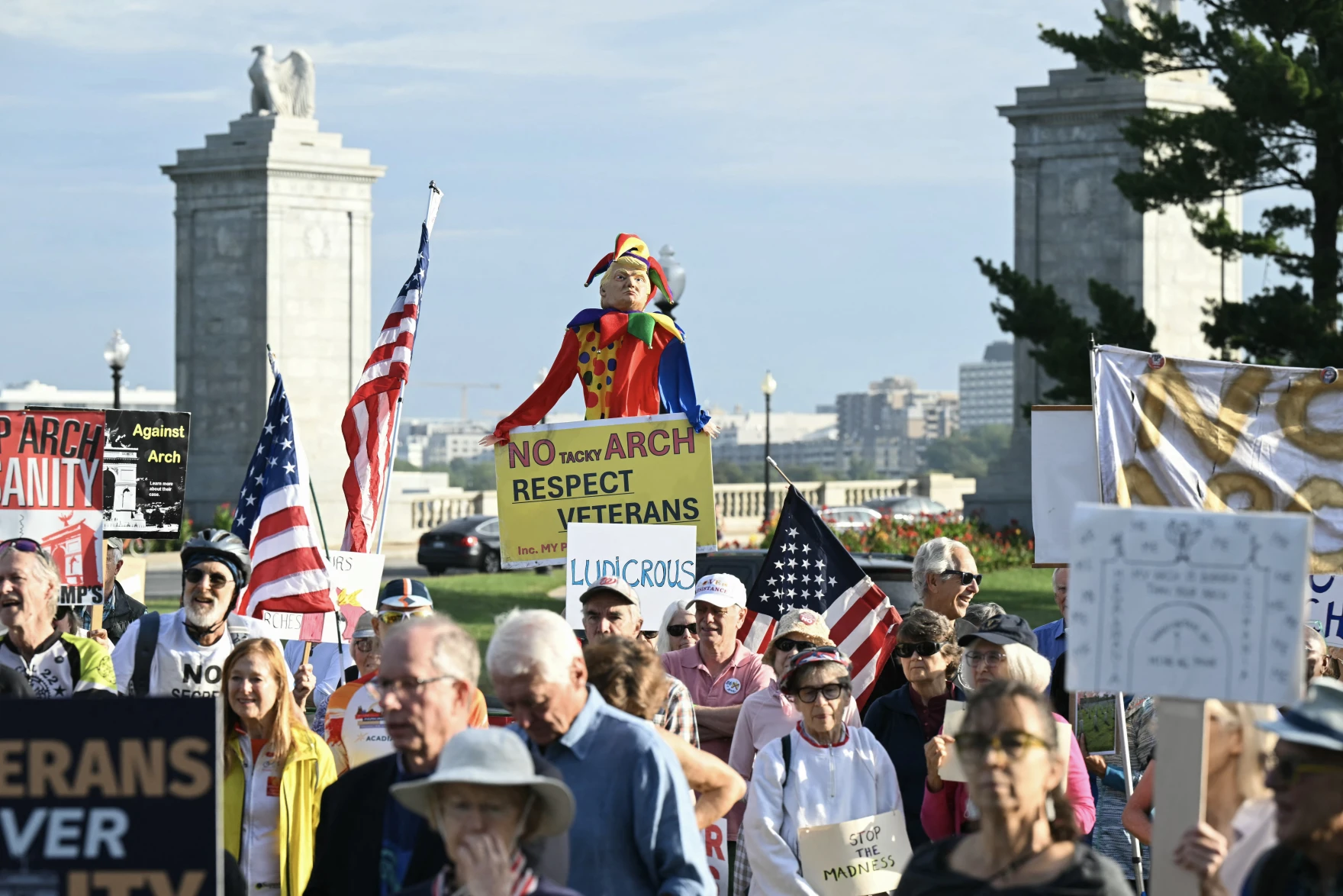
WASHINGTON, D.C. — Veterans, lawmakers and other activists gathered at Memorial Circle Thursday to oppose President Donald Trump’s proposed 250-foot arch near Arlington National Cemetery, citing concerns over its size, cost, federal approval process and potential impact on nearby historic sites.
The protesters held the event during rush hour and displayed a tarp mockup of the proposed structure. Organizers said the actual arch would stand about 32 times taller than the mockup.
The event, called “Vets Over Vanity,” included veterans, retirees and lawmakers who criticized the project’s scale and design and questioned whether Trump has secured the necessary congressional approval.
Jon Gundersen, a retired Army veteran and former Foreign Service officer involved in a lawsuit against the Trump administration over the arch, said the proposed monument would not appropriately honor veterans.
“It’s the wrong monument, in the wrong place, at the wrong time, dedicated to the wrong man,” Gundersen said.
Gundersen traveled from South Carolina for the protest, which Public Citizen helped organize. He said he found the turnout encouraging and said people from both major political parties had expressed opposition to the project.
Concerns over Arlington National Cemetery
Several speakers focused on the arch’s proximity to Arlington National Cemetery and the potential effect on families visiting graves.
Sen. Tammy Duckworth, D-Ill., a military veteran, criticized the project and said the government could instead direct money toward veterans’ services.
The White House has said the arch would “enhance the visitor experience” at Arlington National Cemetery and serve as a visual reminder of the sacrifices of American service members.
Gundersen questioned how the structure would affect families attending funerals at the cemetery.
“It’s not only wrong and inappropriate, it’s obscene and should never [be] done,” he said.
The crowd applauded throughout the roughly 30-minute program and periodically chanted “no arch!” Protesters also joined in a rendition of “We Shall Overcome.” Cyclists and commuters passing Memorial Circle honked and waved in support.
Planes flew over the gathering as protesters also raised concerns about aviation safety. The proposed arch would stand near the approach to one of the region’s busiest airport runways.
Rep. Don Beyer, D-Va., questioned the administration’s plans to incorporate military drones and snipers into the structure.
The White House, Interior Department and Federal Aviation Administration have not responded to questions about the proposed military component.
Federal review moves forward
The proposed arch could come before the National Capital Planning Commission at its next meeting in early November.
The National Park Service had worked with outside groups on ways to reduce the project’s impact on nearby protected landmarks. The park service had also rejected suggestions to relocate the arch.
The Advisory Council on Historic Preservation ended that review process in late September, days after Trump announced plans for the structure to include a military complex.
The council informed historic preservation groups of the decision in an email reviewed by NPR.
Charles Birnbaum, head of The Cultural Landscape Foundation and a participant in the review process, criticized the decision to end the process after two meetings. He said he had seen similar action only twice during his 15 years working for the National Park Service.
The council now plans to send its recommendations directly to Interior Secretary Doug Burgum by Oct. 7.
Critics consider legal and congressional options
Protesters said they would continue opposing the project through legal, congressional and public pressure.
Julius D. “JD” Spain Sr., a member of the Arlington County Board, urged residents to contact their senators and representatives. He also said he would join protesters in removing the structure if it gets built.
Beyer said a large group of people stands ready to protest if construction begins.
Congress could also prevent construction from moving forward if lawmakers block federal funding for the project. Earlier this week, a Republican senator blocked a Democratic effort to prevent federal funding for the arch and the demolition of the Kennedy Center.
The November midterm elections could change the balance of power in Congress, potentially affecting future congressional efforts involving the proposed arch.