
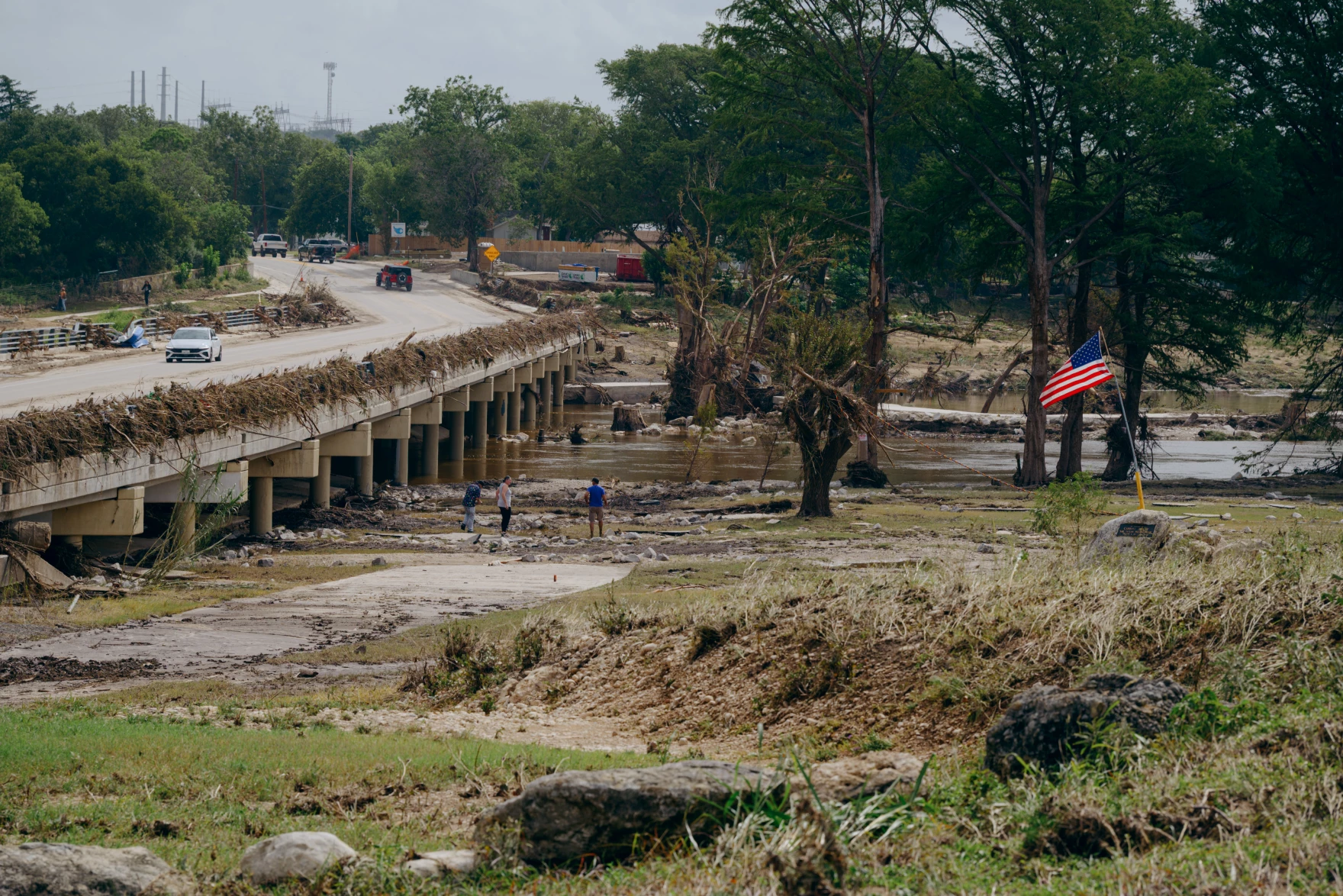
AUSTIN, Texas — Texas Gov. Greg Abbott said Monday that the state’s primary concern remains along the Nueces River as evacuations continued in parts of Uvalde County, even as many communities shifted from rescue operations to recovery following days of catastrophic flooding that killed at least two people and prompted disaster declarations across dozens of counties.
Abbott said officials expect flood risks to persist for at least the next 48 to 72 hours as water continues moving downstream.
“We, as a state and our local communities, still have to get them through the remaining challenges over the next 48 to 72 — maybe even longer than that — hours,” Abbott said.
In Uvalde County, the Nueces River crested at a record 28.01 feet, surpassing its previous high-water mark set in 1996. Floodwaters also destroyed part of the FM 481 bridge southwest of Uvalde, cutting off a key route between Uvalde and Eagle Pass.
“Just because the skies may be clear here right now, doesn’t mean that the aggregation of water that’s flowing downstream has peaked,” Abbott said. “Downstream, the waters will continue to rise and continue to pose dangers for those local communities.”
As floodwaters receded, residents across South Central Texas began clearing debris and repairing damaged homes and businesses while local and state officials assessed losses and coordinated relief efforts.
Abbott said President Donald Trump approved the state’s request for a major disaster declaration on Saturday after Texas sought federal assistance for 28 flood-affected counties.
“The state is working and it will continue to work with local officials to expedite debris removal as well as to accelerate the rebuilding process,” Abbott said.
Preliminary assessments identified damage to at least 490 homes and 100 businesses in Kerr County, along with about 100 homes in neighboring Kendall County, Abbott said. Officials continue to assess damage in other affected areas.
Communities also organized donation drives, cleanup efforts and relief distributions to assist flood victims.
Jesse Rizo, a resident of Batesville, said volunteers continued helping neighbors despite suffering their own losses.
“You’re going to see people that can’t get into their homes, they can’t live in their homes — but those are the very same people that are unloading trucks, the very same people that are in the kitchen cooking,” Rizo told KERA News. “Their hearts are shattered, but where are they at? They’re trying to rebuild somebody else’s shattered heart.”
Many Hill Country communities are recovering from another major flood after last summer’s disaster, which killed more than 130 people.
Kerrville resident Rosalinda Torres said floodwaters reached her home for the first time despite having witnessed previous floods.
“There were 18 of us raised and born here, and I’ve seen all the floods, but I’ve never seen this come into my house,” Torres told Texas Public Radio. “It just breaks my heart.”
The Community Foundation of the Texas Hill Country has launched a flood relief fund to support emergency response and long-term recovery efforts. Abbott also encouraged Texans to donate to the Rebuild Texas Fund, administered by the OneStar Foundation, and acknowledged volunteer organizations assisting recovery efforts, including Texans on Mission, Samaritan’s Purse, Team Rubicon, Operation Blessing and Crisis Response Ministries.